Engineer created an open companion robot from PVC pipes

Post Thumbnail

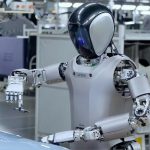
Modern robots can be both expensive and super budget-friendly. And the new humanoid robot ALANA, created for just $70, demonstrates impressive capabilities. Previously unavailable in this price category. 3D printed, this robot not only waves its hand with human smoothness, but also supports dialogue, recognizes faces, and performs complex gestures.

The creator of the ALANA robot, engineer Shashwat Batish, deliberately abandoned some design elements. The robot has no head and legs. However, he equipped the device with functional arms with 6 degrees of freedom. These manipulators are capable of lifting objects weighing up to 500 grams. An impressive figure for a homemade construction.

The physical basis of the humanoid robot consists of a combination of lightweight plastic and inexpensive polyvinyl chloride pipes. Arduino and ESP32 microcontrollers are used for control. The robot gets power from a standard computer unit with 450 watts. Intellectual capabilities are provided by a local chatbot based on a language model, which processes voice commands.

Batish positions his creation not just as a technological demonstrator, but as a companion with character, capable of bringing any space to life. The entire project is built on principles of openness – complete documentation, source code, electrical schematics, and files for 3D printing are freely available on the Instructables platform.

Well, this humanoid robot perfectly demonstrates the potential of combining home 3D printing, affordable electronics, and open-source software. But it looks creepy, to be honest.
Почитать из последнего
UBTech will send Walker S2 robots to serve on China's border for $37 million
Chinese company UBTech won a contract for $37 million. And will send humanoid robots Walker S2 to serve on China's border with Vietnam. South China Morning Post reports that the robots will interact with tourists and staff, perform logistics operations, inspect cargo and patrol the area. And characteristically — they can independently change their battery.
Anthropic accidentally revealed an internal document about Claude's "soul"
Anthropic accidentally revealed the "soul" of artificial intelligence to a user. And this is not a metaphor. This is a quite specific internal document.
Jensen Huang ordered Nvidia employees to use AI everywhere
Jensen Huang announced total mobilization under the banner of artificial intelligence inside Nvidia. And this is no longer a recommendation. This is a requirement.
AI chatbots generate content that exacerbates eating disorders
A joint study by Stanford University and the Center for Democracy and Technology showed a disturbing picture. Chatbots with artificial intelligence pose a serious risk to people with eating disorders. Scientists warn that neural networks hand out harmful advice about diets. They suggest ways to hide the disorder and generate "inspiring weight loss content" that worsens the problem.
OpenAGI released the Lux model that overtakes Google and OpenAI
Startup OpenAGI released the Lux model for computer control and claims this is a breakthrough. According to benchmarks, the model overtakes analogues from Google, OpenAI and Anthropic by a whole generation. Moreover, it works faster. About 1 second per step instead of 3 seconds for competitors. And 10 times cheaper in cost per processing 1 token.