Konpanion creates individual companion robots with textile covering
Post Thumbnail

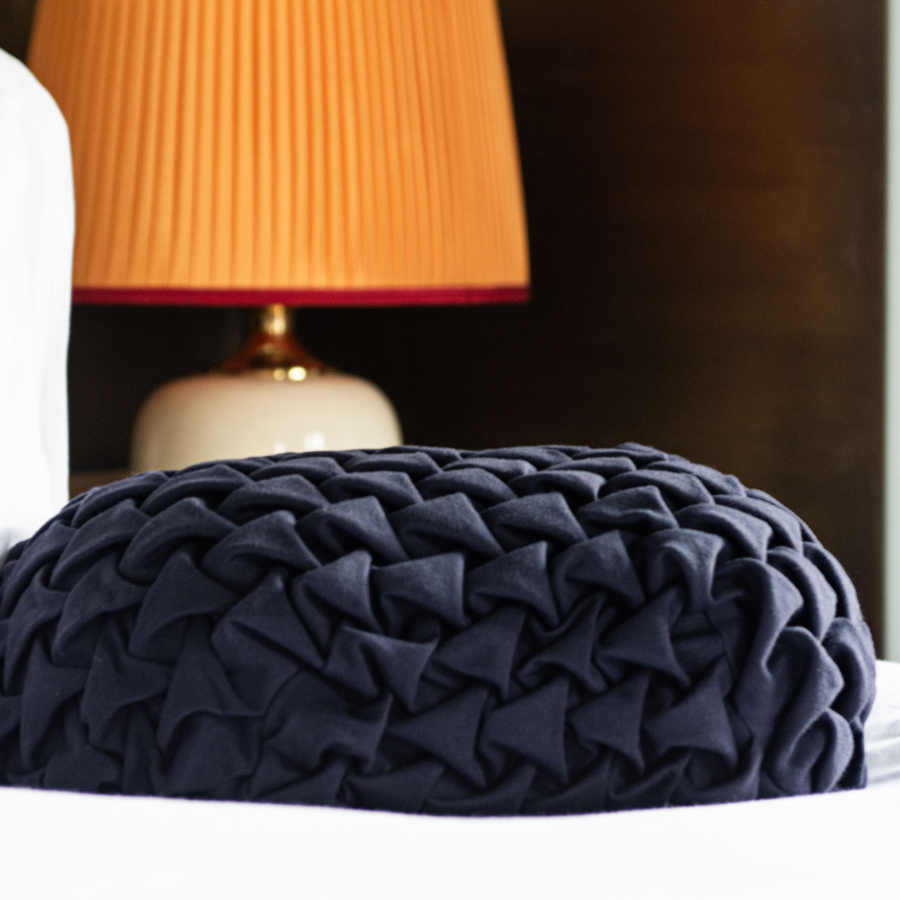
Konpanion company presented its companion robot Maah. Developed at the intersection of robotics, artificial intelligence, and interior design. It focuses not on imitating human communication, but on nonverbal communication characteristic of pets.

The technological architecture of Maah fundamentally differs from traditional companion robots. At the core of the device is a cognitive architecture that imitates animalistic behavior. And capable of expressing emotions through body movements and sounds. The developers paid special attention to sensory systems built on the principle of non-invasive monitoring. Unlike cameras used in most modern smart devices, Maah relies on sound sensors. And the data collected in real-time is visualized in a digital twin of the robot, accessible through an application.

Instead of mass production from plastic, each specimen is created individually using Industry 4.0 principles. The first collection, called Highland Range, is produced in Scotland using natural yarn from the Shetland Islands, which should emphasize the company’s ecological approach.

The physical shell of the robot – the so-called “robe” – is a soft textile covering. Which can be adapted to the aesthetic preferences of the owner and the interior of their home. This approach to design makes Maah not only a functional device but also an element of home furnishing, which remains aesthetically attractive even when turned off. Just no words! I don’t even know what to call it properly now. Companion robot. Or interior item.
Почитать из последнего
UBTech will send Walker S2 robots to serve on China's border for $37 million
Chinese company UBTech won a contract for $37 million. And will send humanoid robots Walker S2 to serve on China's border with Vietnam. South China Morning Post reports that the robots will interact with tourists and staff, perform logistics operations, inspect cargo and patrol the area. And characteristically — they can independently change their battery.
Anthropic accidentally revealed an internal document about Claude's "soul"
Anthropic accidentally revealed the "soul" of artificial intelligence to a user. And this is not a metaphor. This is a quite specific internal document.
Jensen Huang ordered Nvidia employees to use AI everywhere
Jensen Huang announced total mobilization under the banner of artificial intelligence inside Nvidia. And this is no longer a recommendation. This is a requirement.
AI chatbots generate content that exacerbates eating disorders
A joint study by Stanford University and the Center for Democracy and Technology showed a disturbing picture. Chatbots with artificial intelligence pose a serious risk to people with eating disorders. Scientists warn that neural networks hand out harmful advice about diets. They suggest ways to hide the disorder and generate "inspiring weight loss content" that worsens the problem.
OpenAGI released the Lux model that overtakes Google and OpenAI
Startup OpenAGI released the Lux model for computer control and claims this is a breakthrough. According to benchmarks, the model overtakes analogues from Google, OpenAI and Anthropic by a whole generation. Moreover, it works faster. About 1 second per step instead of 3 seconds for competitors. And 10 times cheaper in cost per processing 1 token.