Robot artist Ai-Da creates paintings by hand and moves viewers to tears
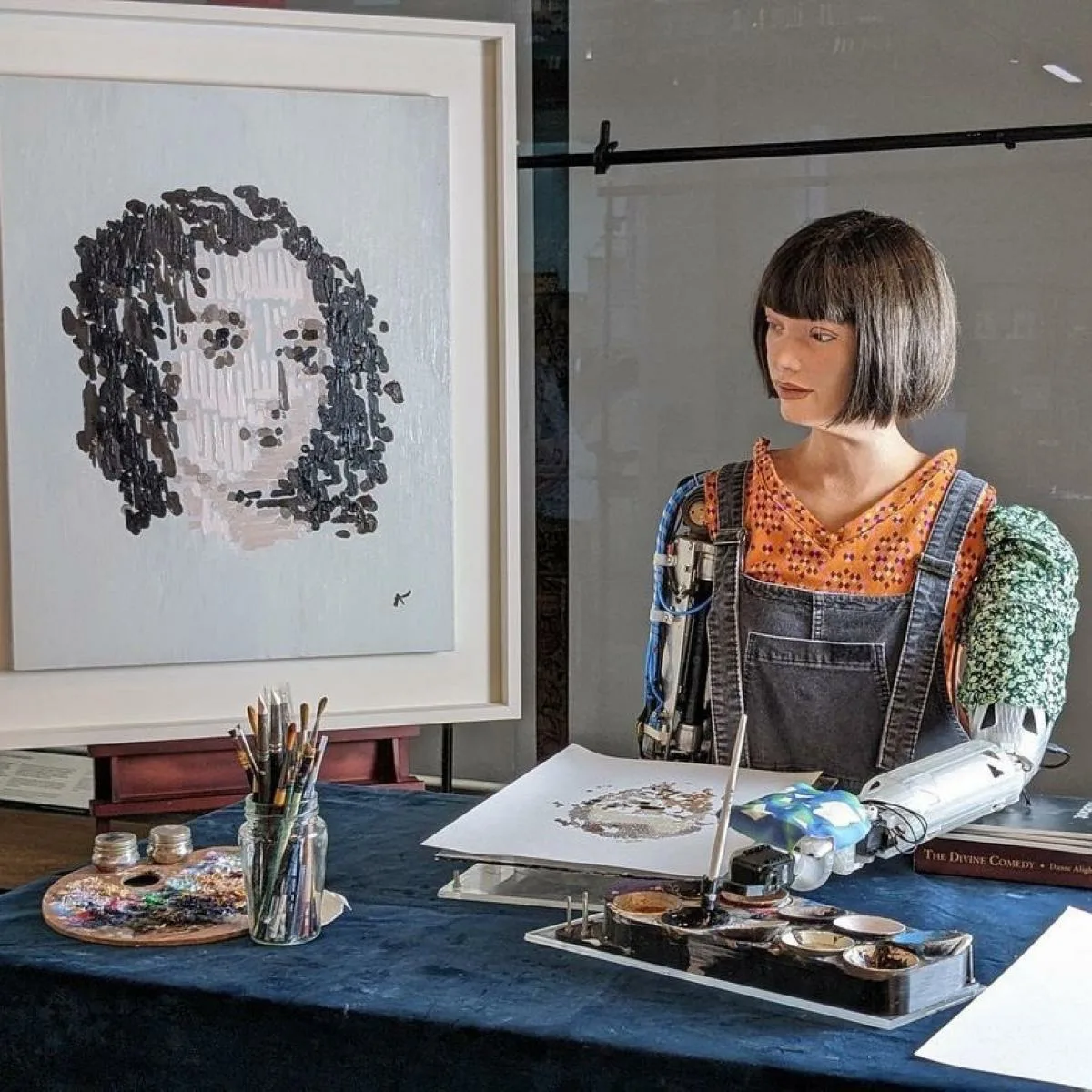
While artificial intelligence penetrates various spheres of online work, a unique robot artist Ai-Da appeared, created by art gallery director Aidan Meller. “Art is a skill. If it’s a skill, a machine can master it,” claims Meller. Named after computing pioneer Ada Lovelace, robot artist Ai-Da physically creates drawings and paintings. Rather, this is a female robot artist – she has a female face, short black wig and 2 robotic arms for drawing.
Cameras in her eyes allow her to maintain eye contact and recognize objects. Although Ai-Da has no emotions, her works evoke strong feelings in viewers – some even cry in front of her paintings. The robot was created by a team of more than 30 programmers, robotics engineers, art historians and psychologists. The idea came to Meller when he was reflecting on the future of art and what makes great artists outstanding.
Studying works of masters from Michelangelo to Warhol, he realized: all great artists reacted to fundamental social changes of their time. So he decided to react. So to speak, proactively.
AIvengo >
Reviews >
Robot artist Ai-Da creates paintings by hand and moves viewers to tears
Почитать из последнего
UBTech will send Walker S2 robots to serve on China's border for $37 million
Chinese company UBTech won a contract for $37 million. And will send humanoid robots Walker S2 to serve on China's border with Vietnam. South China Morning Post reports that the robots will interact with tourists and staff, perform logistics operations, inspect cargo and patrol the area. And characteristically — they can independently change their battery.

AI chatbots generate content that exacerbates eating disorders
A joint study by Stanford University and the Center for Democracy and Technology showed a disturbing picture. Chatbots with artificial intelligence pose a serious risk to people with eating disorders. Scientists warn that neural networks hand out harmful advice about diets. They suggest ways to hide the disorder and generate "inspiring weight loss content" that worsens the problem.
OpenAGI released the Lux model that overtakes Google and OpenAI
Startup OpenAGI released the Lux model for computer control and claims this is a breakthrough. According to benchmarks, the model overtakes analogues from Google, OpenAI and Anthropic by a whole generation. Moreover, it works faster. About 1 second per step instead of 3 seconds for competitors. And 10 times cheaper in cost per processing 1 token.