Ronaldo battled a robot goalkeeper from a NASA engineer and lost

Engineer and popular blogger Mark Rober created a robot goalkeeper and challenged Cristiano Ronaldo. There’s a nuance – he’s a former NASA and Apple employee. So, the machine’s characteristics are impressive: cameras at 500 frames per second, 0.2 second reaction. 24 infrared cameras predict the ball’s trajectory already 0.006 seconds after the shot. Thanks to this, the goalkeeper moves to the corner in a third of a second.
Cristiano Ronaldo shot from different distances and with different techniques. The robot deflected everything. 11 attempts — 11 failures. The Portuguese national team has already laughed at the captain.
But after numerous attempts, the Portuguese figured out the system. Inside the ball was a special sensor that transmitted a signal to the robot. And Ronaldo also noticed a physical limitation. The machine simply doesn’t have time to block a shot to the far corner. The robot is attached to the goal line, moves fast, but not infinitely fast.
And on the 12th try Cristiano scored. He shot exactly where the machine physically didn’t have time. But in the overall count he still lost.
It turns out, artificial intelligence with reaction faster than human, with high-resolution cameras and instant trajectory prediction. And still has a weak point. Cristiano Ronaldo – well done, figured out the system.
AIvengo >
Reviews >
Ronaldo battled a robot goalkeeper from a NASA engineer and lost
Почитать из последнего
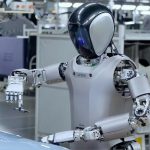
UBTech will send Walker S2 robots to serve on China's border for $37 million
Chinese company UBTech won a contract for $37 million. And will send humanoid robots Walker S2 to serve on China's border with Vietnam. South China Morning Post reports that the robots will interact with tourists and staff, perform logistics operations, inspect cargo and patrol the area. And characteristically — they can independently change their battery.

AI chatbots generate content that exacerbates eating disorders
A joint study by Stanford University and the Center for Democracy and Technology showed a disturbing picture. Chatbots with artificial intelligence pose a serious risk to people with eating disorders. Scientists warn that neural networks hand out harmful advice about diets. They suggest ways to hide the disorder and generate "inspiring weight loss content" that worsens the problem.

OpenAGI released the Lux model that overtakes Google and OpenAI
Startup OpenAGI released the Lux model for computer control and claims this is a breakthrough. According to benchmarks, the model overtakes analogues from Google, OpenAI and Anthropic by a whole generation. Moreover, it works faster. About 1 second per step instead of 3 seconds for competitors. And 10 times cheaper in cost per processing 1 token.