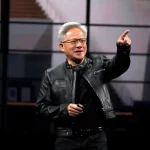
Scale AI CEO and the idea of “winning the AI war with China”

The speech by Scale AI CEO Alexander Wang at the opening of Web Summit Qatar received an unexpectedly cold reception from the international audience, who did not share his militaristic view on the development of artificial intelligence.
Last month, Wang placed a full-page advertisement in The Washington Post with an address to President Trump, claiming that “America must win the AI war.” However, when interviewer Felix Salmon from Axios conducted a poll among those present at the summit, only two hands were raised in support of this opinion. Meanwhile, the “overwhelming majority” of the audience expressed disagreement.
Wang tried to justify his position: “AI will fundamentally change the nature of national security.” He mentioned that he grew up in Los Alamos, New Mexico, “the birthplace of the atomic bomb,” and that both his parents were physicists working at the National Laboratory.
The Scale AI CEO characterized the situation as a race between the US and China, expressing concern that AI would allow China to “leapfrog” the military power of “Western powers,” which was the reason for placing the advertisement.
Wang repeats rhetoric that is increasingly heard from startups in the defense technology sphere and venture capitalists. They advocate for greater autonomy in AI weapons and for increasing the number of such weapons in general. As an example, they cite a hypothetical situation where China releases fully autonomous AI weapons, while the US slows down with the requirement of human participation in decision-making before opening fire.
Beyond hypothetical weapons from another country, Wang tried to justify the necessity of choosing between China and the US regarding basic models of large language models (LLMs). He believes this will also be a race between two players, not mentioning other participants such as the French company Mistral. In his opinion, American models are based on freedom of speech, while Chinese models reflect communist societal views.
Researchers have indeed found that many popular Chinese LLM models have built-in state censorship. Additionally, there are concerns that the Chinese government may create backdoors for data collection in their models.